





2026-09-24
How Do You Select Between Different RF Connectors for a Smart Cockpit?
View More


 FPC/FFC Connector
Board to Board Connector
Wire to Board Connector
Flexible Flat Cable
RF Connector
I/O Header
FPC/FFC Connector
Board to Board Connector
Wire to Board Connector
Flexible Flat Cable
RF Connector
I/O Header
Product

Automotive
Product
 141091-211260
 Consult

Choosing an FPC connector manufacturer involves more than finding a connector that matches the basic dimensions of a PCB or FPC. Also depends on connector configurations, manufacturing capabilities, quality management, and technical support.
For engineers and purchasing teams, details such as pitch, pin count, locking mechanism, insertion direction, and connector height can all affect the final selection. Understanding what to look for in an FPC connector manufacturer can make it easier to compare suitable options and find a solution that fits both the design and production requirements.
Once the basic project requirements are clear, the next step is to check whether the manufacturer's connector range can meet them. Pitch is an important starting point, but other dimensions and configurations also need to work together.
The available pitch needs to match the PCB layout and FPC/FFC requirements. A wider range of pitch options also gives engineers more flexibility when space or connection density changes during development.
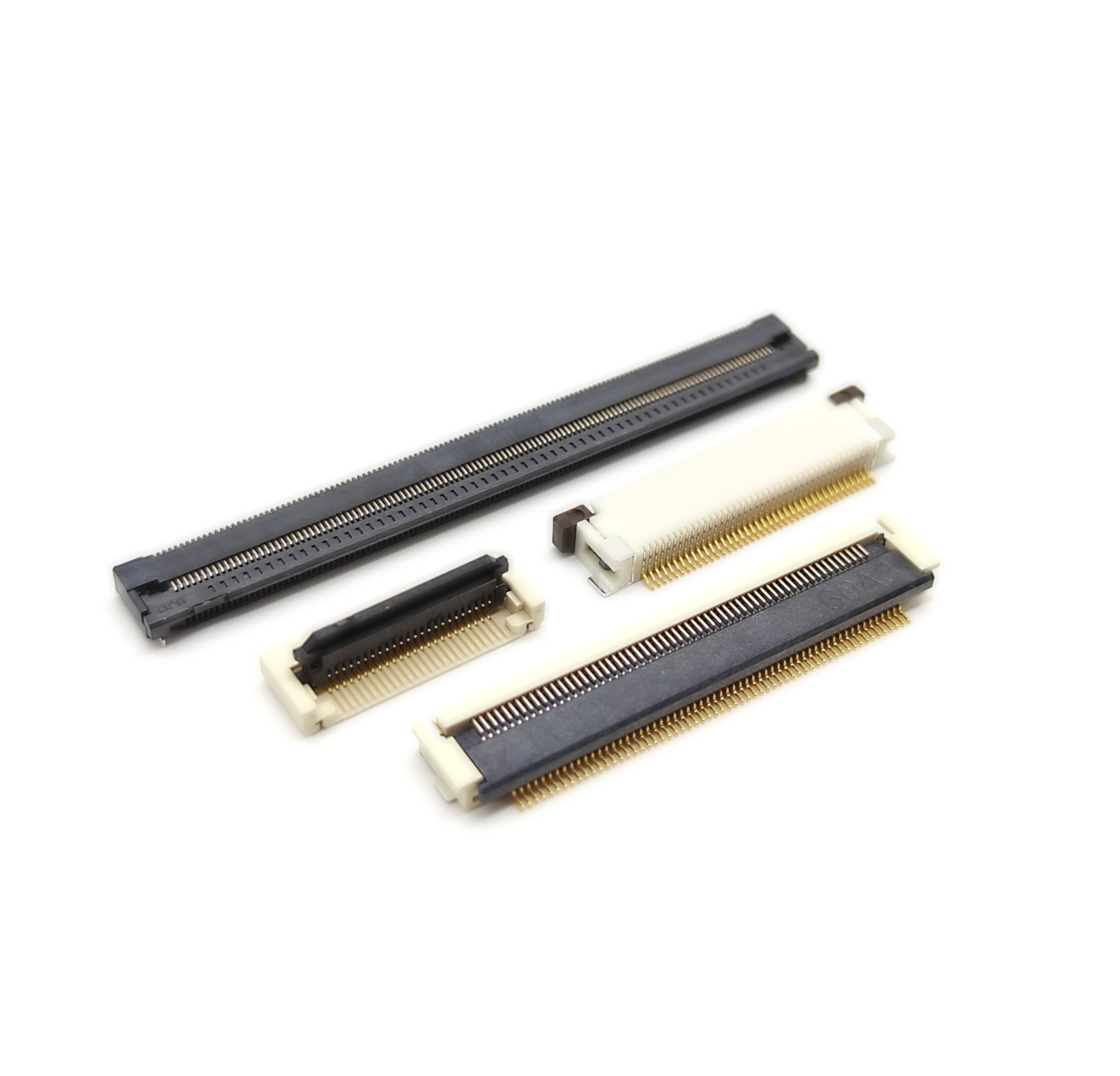
Our FPC/FFC connector solutions include 0.4 mm, 0.5 mm, and 1.0 mm pitch options. The product range currently provides 58 filtering results, making it easier to compare different configurations according to specific project requirements.
Pin count and connector height can directly affect available PCB space and the overall connection design.
For example, the FPC0519 Series supports 4–60 positions with a 0.5 mm pitch and a 1.90 mm height. The FPC0409A Series uses a 0.4 mm pitch, supports 9–12 positions, and has a 0.90 mm height.
These differences show why it is important to consider the complete connector specification instead of selecting a product based on pitch alone.
After confirming the basic dimensions, the next consideration is how the connector will be installed and secured. Locking mechanism and insertion direction can have a direct impact on PCB layout and assembly.
Different FPC/FFC designs may require different ways to secure the cable. The connector range includes slider, front flip, rear flip, side flip, auto lock, and no-lock configurations, along with different ZIF options.
The right locking mechanism depends on the FPC/FFC structure and assembly requirements. Identifying this requirement early can make it easier to narrow down suitable connector options.
Insertion direction is another important consideration when space around the connector is limited.
Horizontal and vertical FPC/FFC insertion configurations are available, giving engineers more flexibility when working with different PCB layouts and assembly spaces.
For compact designs, insertion direction should be considered together with connector height and mounting configuration rather than treated as an isolated specification.
A suitable product range should provide enough flexibility to accommodate different project requirements without making the PCB design depend on a single connector structure.
The FPC/FFC connector range covers multiple series across 0.4 mm, 0.5 mm, and 1.0 mm pitch. Different locking mechanisms and insertion directions are also available, allowing configurations to be compared according to PCB and FPC/FFC requirements.
This flexibility becomes particularly useful when connector requirements become more specific as a project moves from initial design to production.
FPC connectors can be used in a variety of electronic applications, and each application may place different demands on the connector.
The product portfolio covers applications including automotive electronics, industrial control, LED displays, medical, security, and new energy. The broader connector portfolio also includes FPC/FFC, RF, board-to-board, wire-to-board, I/O, and high-speed connectors.
This range makes it possible to consider the connector according to the application's specific connection requirements rather than selecting it based on a single specification.
A suitable connector specification is only one part of the decision. When a project requires ongoing supply, manufacturing experience and production capabilities also become important.
FPC connector and FFC cable production began in 2005, following the establishment of the factory. An automation team was later established in 2014 with the ability to independently design and manufacture automated assembly machines.
This experience supports the development and production of FPC connector solutions while providing a foundation for handling different manufacturing requirements.
Production requirements can change as a project moves from development to volume production.
BJD now has more than 600 team members and more than 60 product series. In 2024, the second factory in Tangxia, Dongguan, began operation with an area of about 10,000 square meters.
These capabilities provide additional support for projects that require a transition from product selection and validation to larger-scale production.
Once connector specifications and manufacturing capabilities have been considered, quality management is another important factor. Consistent quality is particularly important when a connector becomes part of a long-term production program.
IATF16949 certification was achieved in 2007, followed by a VDA6.3 standard audit in 2020. Quality management capabilities also include ISO 9001 and IATF 16949 certification.
These quality systems support quality management throughout connector development and manufacturing.
Testing capabilities can provide additional support when products need to be evaluated against specific requirements.
An internal CNAS-accredited laboratory was established in 2023 and can complete most tests required by LV214 and USCAR.
This allows product evaluation and quality requirements to be addressed more directly during project development.
Even when the main specifications are known, choosing between several connector configurations can still require technical judgment. Direct communication can make the selection process more efficient, particularly when PCB space and FPC/FFC requirements need to be considered together.
One-to-one professional support and free solutions are available for connector selection. Sharing the FPC/FFC requirements, PCB constraints, or preferred connector specifications can help narrow down suitable configurations.
This keeps the selection process focused on the actual application instead of requiring engineers to compare unnecessary options.
Before discussing a connector requirement, it is useful to have the following information available:
Required pitch
Pin count
FPC/FFC type
Locking mechanism
Insertion direction
Mounting requirements
Available PCB space
With these details, the appropriate connector configuration can be identified more efficiently.
At this stage, the selection comes down to several practical questions. Does the manufacturer offer the required specifications? Can it provide suitable connector configurations? Does it have the manufacturing and quality capabilities required for the project? And can technical support be provided when questions arise?
Before making a decision, consider:
Pitch and pin-count options
Connector height and mounting configuration
Locking mechanism
FPC/FFC insertion direction
FPC connector manufacturing experience
Quality management and testing capabilities
Production capacity
Technical support
A manufacturer that can address these areas can provide more than an individual connector. It can also support the project as requirements develop from initial selection to production.
If you already have a connector specification or project requirement, you can contact our FPC connector team with the details. Our team will contact you within 2 working days after receiving your inquiry.
You can also learn more about BJD connector manufacturing and our manufacturing capabilities before discussing your project with our team.