





2026-10-30
How to Choose a Floating Board to Board Connector
View More


 FPC/FFC Connector
Board to Board Connector
Wire to Board Connector
Flexible Flat Cable
RF Connector
I/O Header
Product

Automotive
Product
 141091-211260
 Consult

A lighting board-to-board connector must fit the PCB layout, electrical requirements, and space constraints of the lighting assembly. Whether connecting LED boards or linking a lighting module to a control PCB, the right connector helps engineers manage board spacing, simplify assembly, and maintain a reliable electrical interface.
LED lighting assemblies may contain separate LED boards, driver boards, and control PCBs. The connection method depends on how these boards are positioned, what signals or power they carry, and how much room is available inside the lighting enclosure.
In modular lighting designs, multiple PCBs may need to connect within a limited enclosure. A board-to-board connector can provide a direct interface between adjacent or stacked boards, reducing the need for separate cable assemblies where the layout supports direct mating.
Before selecting a connector, determine whether the boards are parallel, coplanar, or mounted at an angle. Their relative positions will affect the required mating direction, connector height, and assembly sequence.
The connection between an LED board and a driver or control PCB depends on the circuit architecture. Power delivery may require different current-handling capabilities from signal connections, so engineers should identify each contact's function before choosing the connector.
A board-to-board connector is not automatically the best choice for every lighting circuit. If the boards are separated, move independently, or require flexible routing, a wire-based connection may be more suitable.
Direct board-to-board connections can save cable-routing space and support compact assemblies. Wire-based connections offer more flexibility when boards are separated or their positions vary.
The practical choice depends on enclosure geometry, assembly access, service requirements, and electrical load. Comparing these factors early helps avoid redesigning the PCB or mechanical structure later.
Lighting connectors must match the electrical demands of the circuit rather than the application name alone. LED power circuits, control signals, and monitoring connections may have different requirements.
Check the connector's rated current and voltage against the intended circuit conditions. Also consider contact resistance, the number of contacts carrying current, and the manufacturer's rating conditions.
A connector's per-contact current rating should not be treated as the total current capacity of the complete assembly. Actual performance depends on the connector configuration, operating conditions, and applicable derating requirements.
LEDs and their driver circuits can generate heat, so connector selection should account for the temperature around the mating interface—not just the ambient temperature outside the luminaire.
Check the connector's operating temperature range and evaluate whether the expected local temperature remains within its specified limits. The connector rating alone does not establish the thermal suitability of the entire lighting assembly.
Lighting enclosures can impose strict limits on board spacing and component height. Connector dimensions therefore need to match the mechanical design as well as the electrical circuit.
Pitch determines the spacing between adjacent contacts, while mated height affects the distance between connected boards. Pin count must accommodate the required power, signal, and control connections.
For compact designs, BJD's board-to-board connector range includes different pitches and configurations. Available options include 0.4 mm and 0.8 mm pitch products, with specific models offering different contact counts and mated heights. These dimensions help narrow the selection, but each candidate still needs to be checked against the actual PCB layout and circuit requirements.
During lighting assembly, PCB positioning errors can make connector mating difficult or place stress on the contacts. A floating connector may help accommodate a defined amount of board misalignment, provided its floating range matches the assembly tolerance.
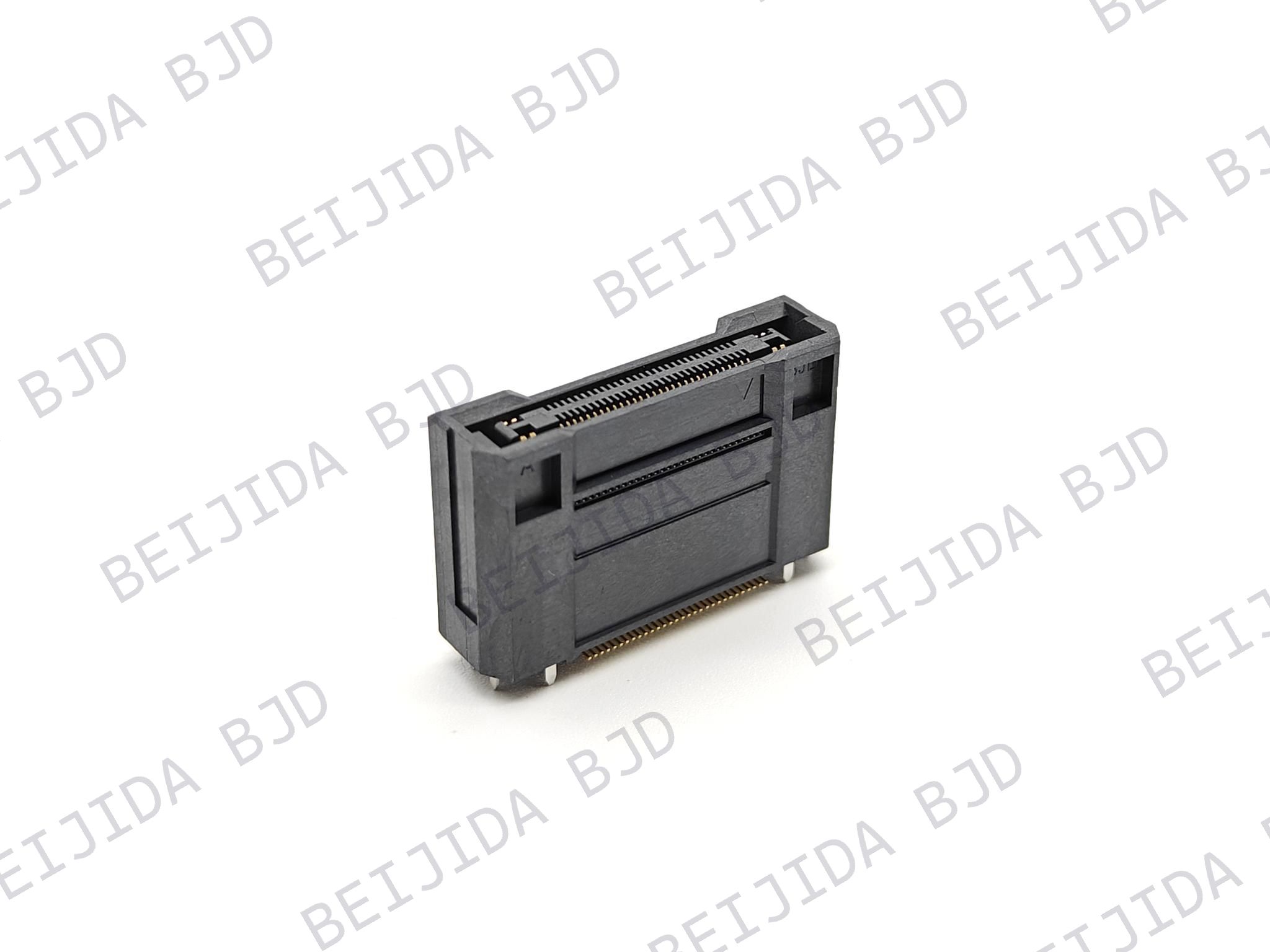
BJD's 0.4 mm floating board-to-board series has a 3 mm mated height and an XY floating range of ±0.4 mm. It offers 20, 30, 40, 50, and 60 contacts, with a rated current of 0.4 A and rated voltage of 50 V. These specifications make it a candidate for compact layouts that need alignment tolerance, but its electrical ratings must be verified against the lighting circuit before use.
Straight and right-angle connectors serve different layout needs. A straight configuration may suit boards that mate vertically, while a right-angle configuration can support a horizontal connection where enclosure height is restricted.
Engineers should also consider component clearance, soldering access, mating direction, and whether the connector can be assembled without interfering with the LED board or heat-management structure.
Lighting products operate in different environments. An indoor commercial luminaire and an automotive lamp may face very different temperature, vibration, and installation conditions, so connector requirements should be based on the actual application.
Temperature changes can cause PCB materials and mechanical supports to expand and contract differently. Connector alignment, contact stability, and mounting strength should therefore be considered across the intended operating range.
Automotive lighting may also require evaluation under vibration and other vehicle-specific environmental stresses. BJD's automotive electronics solutions include automotive lamp applications, but the suitability of an individual board-to-board connector must be confirmed against the relevant design and validation requirements.
Review the connector's specified temperature range, current and voltage ratings, mating configuration, and applicable reliability data. The complete assembly should then be evaluated under representative operating conditions.
Testing should reflect the real lighting design, including board alignment, mechanical mounting, thermal exposure, and electrical load. This helps identify potential issues before the design moves into volume production.
Choosing a connector involves balancing several constraints rather than maximizing a single specification.
A smaller pitch or lower mated height may help fit a connector into a compact lighting enclosure. However, the PCB still needs sufficient space for component placement, routing, mounting, and reliable assembly.
The best choice is the one that fits the complete mechanical and electrical design—not simply the connector with the smallest dimensions.
Direct mating can reduce cable-routing requirements between closely positioned boards. Wiring may be more practical when the layout needs flexible positioning, easier access, or separation between the LED board and its driver.
Compare the complete assembly, including connector count, cable routing, assembly steps, and maintenance needs, before deciding which connection method offers the better fit.
A low initial component cost does not necessarily mean a lower overall system cost. Assembly complexity, alignment issues, rework, and replacement requirements can also affect the cost of a lighting product over its lifecycle.
Set the essential electrical and mechanical requirements first, then compare compatible connector options against cost and manufacturing needs.
At BJD, we provide board-to-board connector options in different pitches, contact counts, mounting orientations, and mating configurations. These choices allow engineers to evaluate connector dimensions and electrical characteristics against the requirements of their lighting PCBs.
Our product range includes compact floating options as well as other board-to-board configurations. Selection should be based on the actual circuit load, board spacing, alignment tolerance, operating temperature, and assembly method rather than assuming one series suits every lighting application.
To help identify a suitable option, prepare the PCB layout, required pin count, target mated height, current and voltage requirements, and expected operating temperature. You can then contact BJD for connector selection support to discuss the application and confirm the relevant product specifications.
A suitable lighting board-to-board connector must meet the electrical demands of the circuit while fitting the lighting assembly's available space, board arrangement, and operating environment. Pitch, mated height, contact count, alignment tolerance, and thermal conditions all influence the final selection.
At BJD, we help customers evaluate board-to-board connector options against their design requirements. Share your PCB layout and key specifications with our team to discuss a suitable connector solution for your LED or automotive lighting project.