





2026-10-30
How to Choose a Floating Board to Board Connector
View More


 FPC/FFC Connector
Board to Board Connector
Wire to Board Connector
Flexible Flat Cable
RF Connector
I/O Header
Product

Automotive
Product
 141091-211260
 Consult

Selecting a board-to-board connector supplier involves more than comparing prices and product dimensions. The connector must fit the PCB layout, meet electrical and mechanical requirements, withstand the operating environment, and remain consistent throughout mass production. A mismatch in any of these areas can lead to assembly difficulties, connection failures, redesign costs, or production delays.
For OEMs, electronics manufacturers, and engineering teams, choosing the right board to board connector factory means evaluating both product suitability and the supplier's ability to support the project from initial design to ongoing production. Understanding the key evaluation criteria helps buyers reduce technical risks and make more informed sourcing decisions.
Before comparing factories, establish the technical requirements of your application. A clear specification allows suppliers to recommend suitable connector configurations and helps prevent costly changes later in development.
Start with connector pitch, pin count, mating height, mounting orientation, and PCB layout. Pitch determines the spacing between adjacent contacts, while pin count affects the number of available connections. Mating height influences the distance between two PCBs and the space available for other components.
These dimensions must work together within the mechanical constraints of the finished product. A connector that meets the required pin count but exceeds the available height may not be suitable for the design.
Rated current, voltage, contact resistance, and signal transmission requirements should also be considered. Power connections and high-speed signal interfaces may require different contact arrangements and electrical characteristics.
If the application carries high-speed signals, review the relevant transmission specifications and system-level signal integrity requirements. Do not assume that connectors with similar dimensions will deliver equivalent electrical performance.
PCB positioning, component placement, and mechanical alignment can affect mating reliability. Where two boards may shift slightly during assembly, a floating board-to-board connector may help accommodate specified misalignment.
However, floating capability should be selected according to the actual tolerance stack-up. It does not eliminate the need for accurate PCB design, mounting control, and assembly validation.
Once the requirements are defined, evaluate whether the factory can manufacture products that meet them consistently. Manufacturing capability matters not only for initial samples but also for repeat orders and production ramp-up.
Connector manufacturing may involve precision stamping, injection molding, terminal plating, and automated assembly. Each process can affect dimensional accuracy, contact performance, and product consistency.
Ask how critical dimensions are controlled, how tooling wear is monitored, and how production deviations are handled. A capable factory should be able to explain its manufacturing processes and identify the controls used for important product characteristics.
Engineering support is particularly valuable when a standard connector does not fully match the PCB layout or mechanical requirements. Discuss whether the supplier can review drawings, confirm mating compatibility, and clarify the limitations of a proposed configuration.
Early technical communication can reveal problems before tooling, PCB fabrication, or assembly begins. It also helps establish whether the supplier understands the application rather than simply matching a product to a short specification list.
A factory should be able to explain how it manages production volumes, process changes, and delivery planning. Sample availability alone does not establish readiness for mass production.
During supplier evaluation, ask about capacity planning, incoming material controls, production traceability, and procedures for handling nonconforming products. These factors help determine whether the supplier can support the project beyond its initial qualification stage.
A suitable factory should offer connector options that align with the design instead of forcing every application into one standard configuration. Product selection should reflect the board layout, required mating height, connection density, and electrical performance.
Fine-pitch connectors can help accommodate dense PCB layouts, while larger pitches may be more appropriate for applications with different mechanical or electrical requirements. The correct choice depends on the available space, number of connections, assembly process, and electrical specifications.
Mating height is equally important in compact equipment. Confirm the combined height of the mating pair and its compatibility with the surrounding components, enclosure, and board spacing.
Floating board-to-board connectors can provide a defined range of movement to help compensate for certain PCB alignment tolerances during mating. This can be useful in assemblies where two boards must connect despite small positional variations.
The required floating range should be evaluated alongside the mounting method, mating height, contact count, and assembly conditions. Buyers should also confirm whether the selected mating pair supports the required movement in the relevant directions.
Some applications require signal contacts only, while others need both signal and power connections. In these cases, the connector's contact arrangement, current rating, voltage rating, and thermal conditions must be reviewed together.
For high-speed designs, confirm the relevant transmission specifications and validate performance in the intended system. Connector selection should be based on documented parameters and application testing rather than a single headline specification.
To compare available configurations, review our board-to-board connector product range, where options can be assessed by parameters such as pitch, mating height, floating range, and connection orientation.
Quality should be evaluated through measurable controls and relevant evidence, not just general claims about reliability. Buyers need to understand how the factory checks products and maintains consistency between batches.
Ask which dimensional, electrical, and mechanical checks are relevant to the connector being considered. Depending on the product and application, evaluation may include dimensional inspection, electrical continuity, contact resistance, mating durability, vibration, or environmental testing.
Not every connector requires the same test plan. The appropriate checks depend on its design, operating environment, applicable standards, and end-product requirements.
Traceability helps manufacturers investigate defects and identify potentially affected production batches. Ask whether the supplier can trace relevant production information, materials, inspection results, and corrective actions.
Clear procedures for nonconforming products are also important. The factory should be able to explain how issues are isolated, investigated, corrected, and prevented from recurring.
Samples should be evaluated against the approved drawings and specifications before mass production. Check dimensional fit, mating compatibility, mounting quality, and electrical performance under the conditions relevant to the application.
Where necessary, conduct assembly trials or system-level testing using the actual PCB design. Sample approval should establish a clear technical baseline for subsequent production rather than relying on visual inspection alone.
After technical and quality reviews, confirm that the factory can support the project's schedule and purchasing requirements. A connector may meet every engineering specification but still create difficulties if production planning and communication are inadequate.
Discuss sample lead time, tooling requirements where applicable, expected production volume, forecast changes, and delivery schedules. Clarify which factors could affect lead times, including material availability and changes to approved specifications.
A realistic production plan is more useful than an unqualified promise of fast delivery. Both sides should understand the expected volumes, order cadence, and process for communicating schedule changes.
Connector projects may involve changes to materials, tooling, dimensions, or manufacturing processes. Buyers should understand how the supplier communicates changes and whether customer approval is required before implementation.
Keeping drawings, specifications, sample approvals, and revision records aligned reduces the risk of different versions being used during production.
Unit price is only one part of sourcing cost. Tooling, validation, assembly efficiency, defect handling, logistics, and the risk of redesign can all affect the total cost of a connector project.
A slightly lower quoted price may not provide better value if the product creates repeated assembly issues or requires extensive engineering changes. Evaluate quotations against the same technical specification and production assumptions to make a fair comparison.
At BJD, we provide connector solutions for applications with different PCB layouts, connection requirements, and mechanical constraints. Our board-to-board connector portfolio includes options with different pitches, mating heights, contact counts, and floating configurations, helping engineering teams assess products against their design requirements.
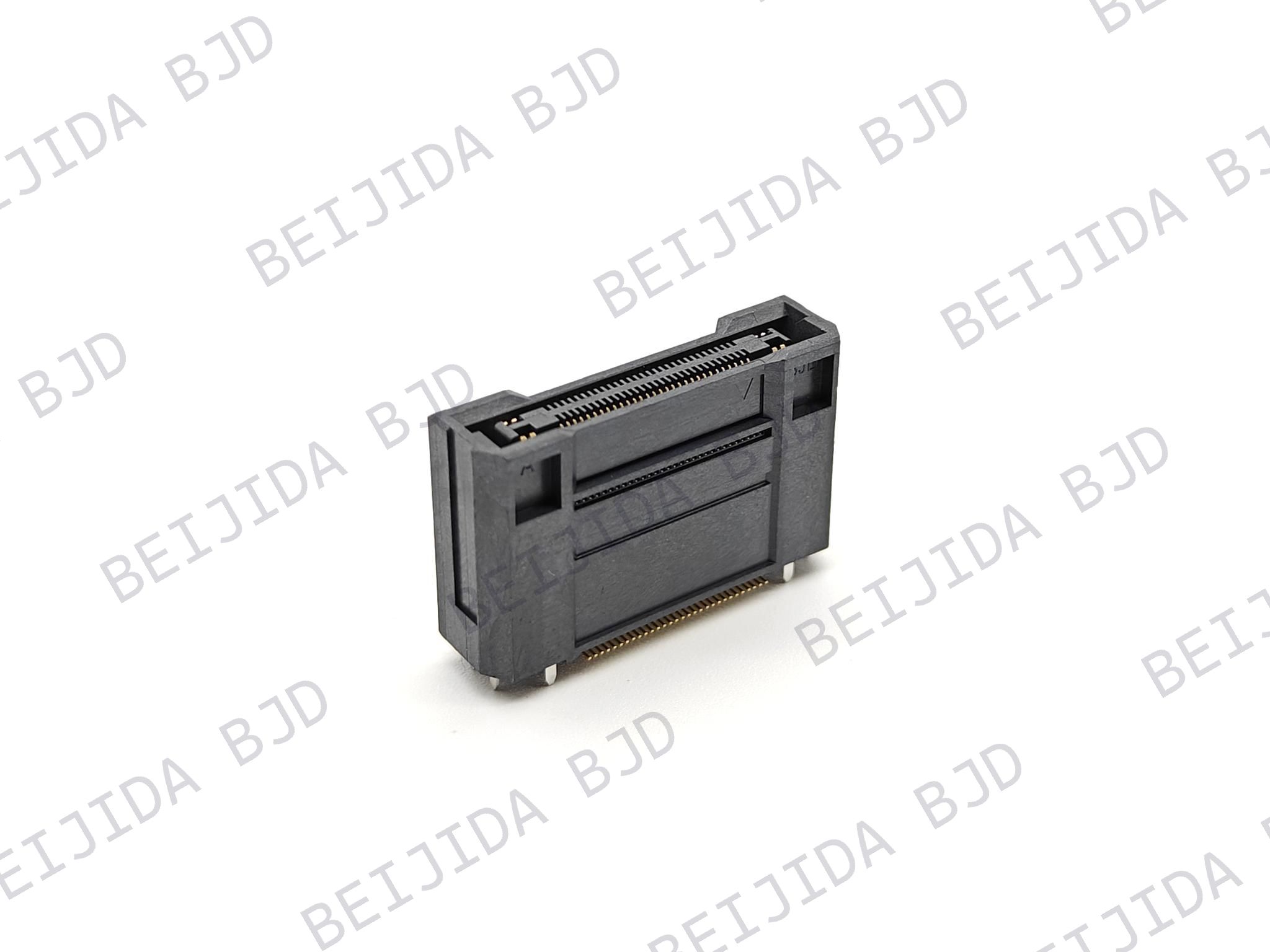
Our board-to-board connector range includes floating and non-floating options for different design needs. For compact assemblies, our 0.4 mm floating board-to-board connector series features a 3 mm mating height, 20–60 contact options, and an XY floating tolerance of ±0.4 mm.
These specifications provide a starting point for evaluating fit, but final selection should always be based on the complete product requirements and mating configuration.
BJD's manufacturing and quality infrastructure supports connector development and production. Our company profile identifies an internal CNAS-accredited laboratory, with testing capabilities relevant to requirements such as LV214 and USCAR. The specific validation plan should still be confirmed against the selected product and the customer's application.
We encourage customers to share their PCB drawings, target mating height, electrical requirements, operating conditions, and estimated order volumes. This information helps us evaluate suitable configurations and clarify technical questions before a design is finalized.
Choosing a board to board connector factory requires a balanced evaluation of technical compatibility, manufacturing capability, quality control, and production readiness. Buyers should begin with clear PCB and electrical requirements, verify the supplier's processes, validate samples, and establish realistic expectations for mass production.
The right supplier should do more than provide a connector that fits. It should help reduce design uncertainty, maintain product consistency, and support the project as requirements evolve.
At BJD, we offer connector solutions for different PCB designs and application requirements. Contact us today to discuss your project needs and request a quotation for a suitable board-to-board connector.