





2026-11-20
How Do Board to Board Connectors Support EV Electronic Systems?
View More


 FPC/FFC Connector
Board to Board Connector
Wire to Board Connector
Flexible Flat Cable
RF Connector
I/O Header
Product

Automotive
Product
 141091-211260
 Consult

Finding a competitive FPC connector involves more than comparing prices. Buyers need to consider product quality, specification compatibility, and supply support alongside purchasing costs. A connector that looks economical may create additional expenses if it requires PCB redesign, causes assembly difficulties, or fails to meet the application's requirements.
The goal is to find a solution that balances these factors. By understanding the key differences between connector structures, materials, and supplier capabilities, purchasing teams can make more informed decisions and identify suitable alternatives for their projects.
A competitive FPC connector provides an appropriate balance between price, quality, product options, and supplier support. A low unit price is attractive, but it should not come at the expense of electrical performance or mechanical reliability.
The overall value of a connector depends on more than its quotation. Material selection, manufacturing processes, product structure, and compatibility with the existing design all influence purchasing decisions.
Choosing unnecessary specifications may increase costs without improving product performance. Conversely, selecting a connector based only on price may introduce quality or compatibility risks. Buyers should first identify essential application requirements and then compare products that meet those requirements.
Material quality, terminal structure, and manufacturing consistency influence the reliability of an FPC connection. A competitive product should meet the required performance standards while maintaining reasonable purchasing costs.
This is why technical specifications and quality requirements should be evaluated alongside price rather than treated as separate considerations.
Cost advantages can come from material selection, manufacturing efficiency, suitable product configurations, and alternative sourcing options. Understanding these factors helps buyers find products that offer better overall value.
Conductive terminals and insulating housings must meet the electrical, mechanical, and environmental requirements of the application. Different materials and manufacturing processes can affect both product performance and production costs.
The objective is to choose materials that satisfy the required specifications without adding unnecessary expenses. A practical connector structure can also help balance manufacturing complexity and product cost.
Selecting the right specifications is another way to control purchasing costs. Before requesting quotations, buyers should confirm the required pitch, pin count, connector height, contact position, and locking structure.
For projects using existing components, evaluating compatible alternatives can provide additional sourcing options. BJD's 101001-20XX50, for instance, is listed as a compatible replacement option for IRISO 9631, 9632, 9633, and 9634 series, as well as Kyocera 6222, 6223, 6239, 6268, 6269, and 6210 series.Its compatibility information gives purchasing teams another option to evaluate when reviewing existing designs.
However, a compatible replacement should still be checked against the original connector's drawings, PCB footprint, and cable requirements before adoption.
Cost optimization should not mean accepting unsuitable materials or inconsistent manufacturing quality. An FPC connector is a small component, but its electrical contacts and mechanical structure are essential to maintaining a reliable connection.
Conductive terminals provide the electrical connection, while the insulating housing supports the contact structure. Both require materials suitable for the intended operating conditions.
The locking mechanism also matters. ZIF connectors use an actuator to secure the FPC or FFC after insertion. Its structure should suit the cable design and assembly process.
Electrical specifications commonly include rated current, rated voltage, and contact resistance. Mechanical considerations include connector dimensions, terminal retention, actuator operation, and cable connection stability.
These factors should be evaluated together. Suitable electrical ratings alone do not guarantee that a connector will fit or function properly in the finished product.
Consistent dimensions and terminal positioning are important for PCB assembly. Variations between production batches may create installation difficulties or affect product performance.
When evaluating suppliers, buyers should consider dimensional inspection, material verification, electrical testing, and manufacturing process controls. Clear technical documentation also helps reduce communication errors during product development and purchasing.
FPC connectors are available in different configurations to accommodate varying PCB layouts, cable designs, and assembly requirements. Understanding these differences helps engineers identify suitable products.
Pitch refers to the center-to-center distance between adjacent contacts. Common options include 0.4 mm, 0.5 mm, and 1.0 mm.
A smaller pitch can accommodate more contacts in limited space, but it also requires careful PCB layout and assembly. Pin count should correspond to the number of electrical connections required by the circuit.
ZIF connectors use a locking mechanism to secure the flexible cable after insertion. This structure can reduce insertion force and provide a controlled locking operation.
Non-ZIF connectors use a different contact structure without the same type of actuator. Their suitability depends on the cable design and assembly requirements.
BJD offers both structural options. For projects requiring vertical insertion, our 1.0-5 Series provides a ZIF slider-lock configuration. This gives buyers an additional option when reviewing existing connector designs.
FPC connectors may use upper-contact, bottom-contact, or dual-contact configurations. The correct choice depends on the position of the conductive pads on the flexible cable.
Mounting orientation is equally important. Horizontal SMT and vertical SMT connectors have different installation requirements. Buyers should confirm the insertion direction and available clearance before making a selection.
Connector height, length, width, and mounting footprint should be checked against the PCB layout. The FPC/FFC must also match the connector's pitch, pin count, thickness, and contact orientation.
For replacement projects, comparing technical drawings is particularly important. Even small differences in terminal positioning or housing dimensions may affect PCB compatibility.
The most suitable connector depends on how it will be installed and operated in the finished product. Considering application requirements early helps narrow down the available options.
Compact electronic products may have limited clearance between the PCB and surrounding components. Connector height and insertion direction therefore become important selection factors.
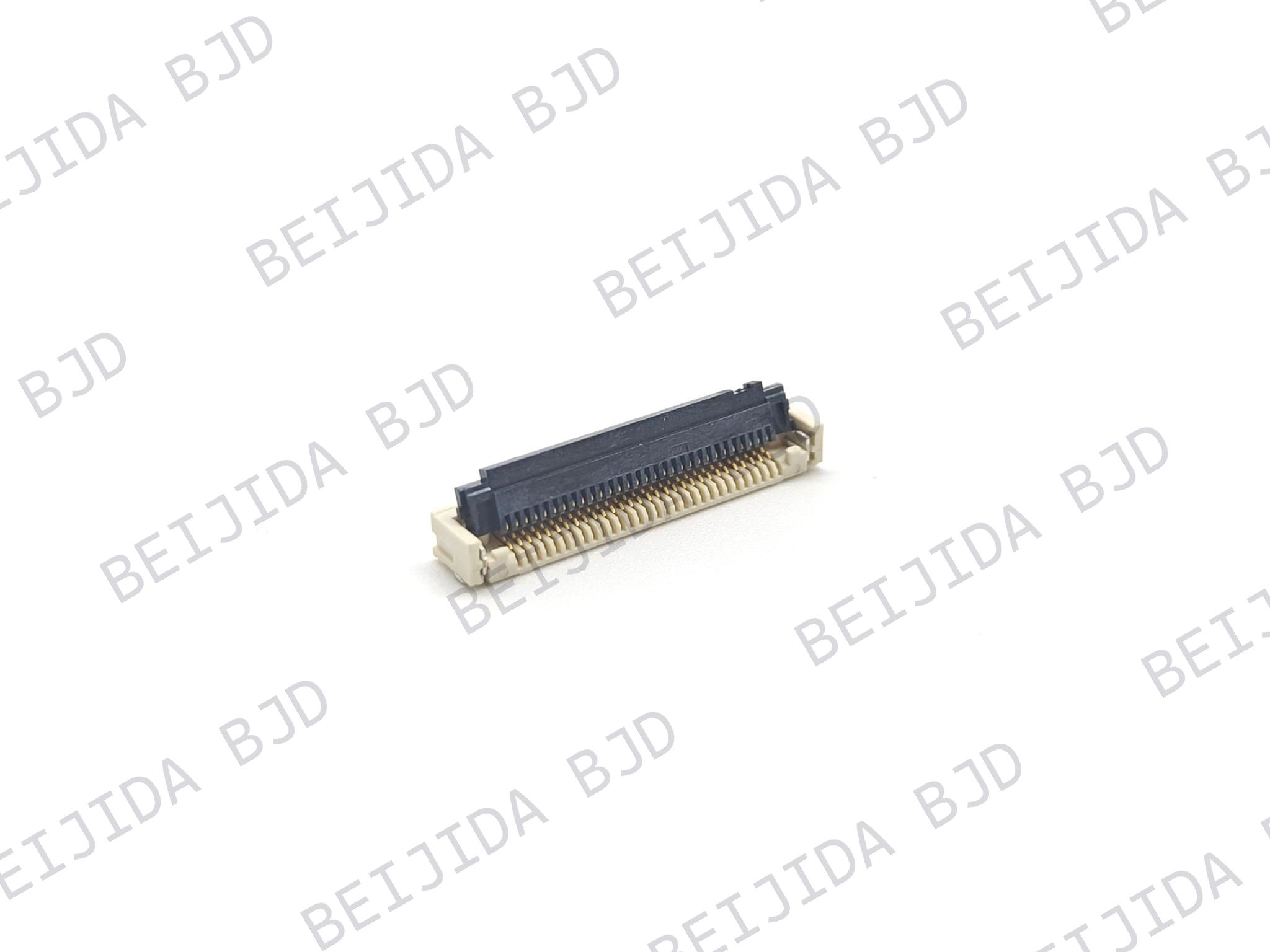
For horizontal SMT designs, BJD's 101101-20XX50 is one option to consider. It belongs to the 0.5-25 Series and uses a front-flip ZIF structure. This product is designed for FPC/FFC cables with tabs, making cable configuration an important part of the selection process. Its relatively compact 2.00 mm connector height is also relevant when evaluating available installation space.
Rated current, voltage, and operating temperature should correspond to the actual application conditions. Buyers should check these parameters against circuit requirements and the expected operating environment.
Where additional environmental requirements exist, they should also be clarified with the supplier before selecting the connector.
The connector must suit the intended PCB assembly process and cable installation method. Buyers should confirm whether the design requires horizontal or vertical insertion and whether the FPC/FFC uses locking tabs.
Checking these details in advance can help prevent assembly problems and unnecessary design changes.
A competitive connector solution also depends on the supplier's ability to support the project beyond the initial quotation. Product availability, technical communication, and manufacturing consistency all influence long-term purchasing decisions.
A broad product range gives engineers more options when selecting pitch, pin count, connector height, contact position, and mounting orientation.
Some applications involve dimensional or structural requirements that cannot be fully met by standard products. In these situations, clear communication between the customer and supplier is essential.
Providing technical drawings, cable specifications, and application details helps the supplier evaluate requirements. If customization is needed, development scope, samples, and validation requirements should be clarified before production.
Buyers should consider how suppliers maintain consistent product specifications across production batches. They should also discuss order requirements, delivery expectations, and communication procedures.
These factors help determine whether a supplier can support ongoing purchasing needs rather than simply fulfilling an initial order.
After identifying technical and purchasing requirements, buyers need a practical method for comparing different products and suppliers.
Model numbers are useful for product identification, but they do not guarantee compatibility between manufacturers. Buyers should compare pitch, pin count, connector dimensions, contact arrangement, locking structure, mounting method, and electrical ratings.
Technical drawings and specification sheets provide a more reliable basis for comparison.
A useful comparison should answer three questions:
Does the connector meet the application's technical requirements?
Does it provide the necessary quality and performance?
Can the supplier support the project's purchasing and technical needs?
Considering these factors together helps buyers avoid choosing a product based only on its initial price.
Before confirming an order, buyers should review product documentation, clarify technical questions, and evaluate samples where necessary.
For replacement projects, the proposed connector should be checked against the original design and tested under actual assembly conditions. For ongoing production, buyers should also understand how the supplier manages product consistency and repeat orders.
At BJD, we provide FPC/FFC connectors with different pitches, pin counts, locking structures, contact configurations, and mounting orientations. Our product range gives customers multiple options when balancing cost and design requirements.
Beyond standard specification choices, several BJD products are identified as compatible replacement options for connector series from established manufacturers. These include options for Kyocera, Molex, and IRISO products, covering different pitches and mounting configurations.
We recommend comparing the relevant product drawings and technical parameters before selecting an alternative. Our team can also help review connector requirements and discuss suitable options for specific applications.You can explore our FPC/FFC connector range to identify products that match your design and purchasing requirements.
Finding a competitive FPC connector requires balancing cost, product quality, specification compatibility, and supplier support. A low purchase price alone does not guarantee better value. Material selection, connector structure, electrical performance, and manufacturing consistency all influence product suitability.
At BJD, we offer different FPC/FFC connector configurations and compatible replacement options to support varying design and purchasing requirements. By comparing application needs with product specifications, buyers can identify a solution that balances cost, quality, and compatibility.